
Best BBA colleges in South India: BBA + ACCA or CMA? Which path should you choose?
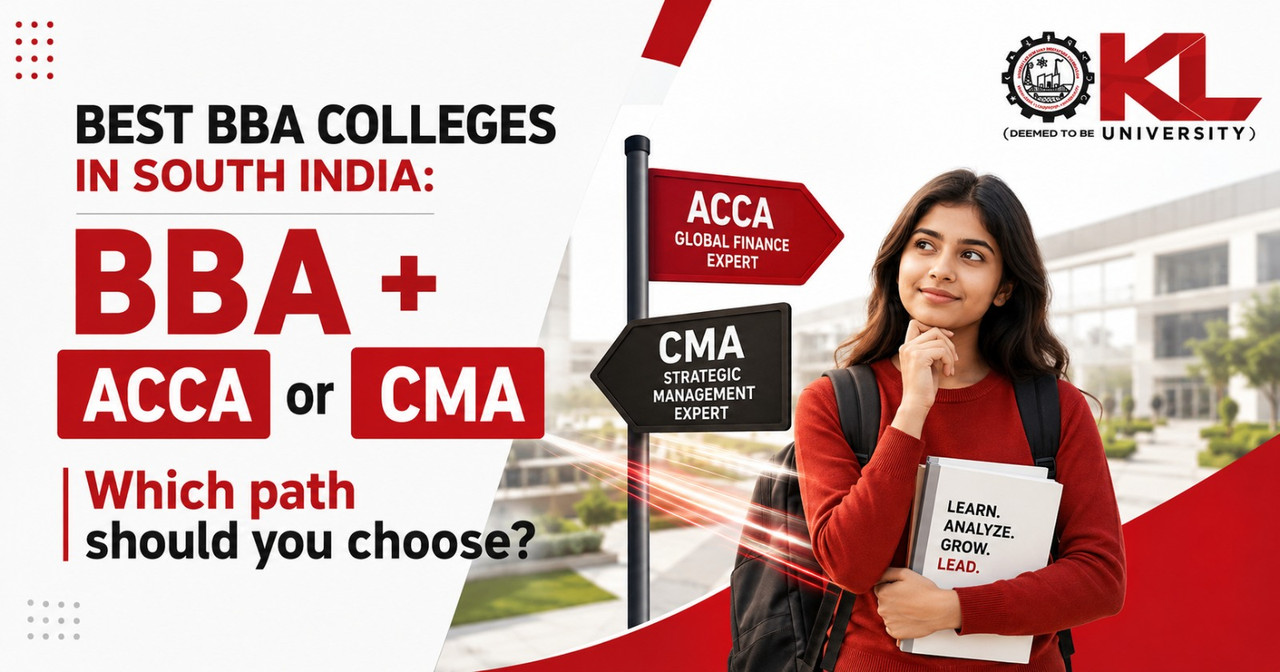
BBA + ACCA and BBA + CMA both combine business education with a professional accounting qualification, but they prepare you for different kinds of finance careers. ACCA is a stronger fit for accounting, audit, taxation and financial reporting, while CMA focuses more on costing, budgeting, performance and business decisions. Students comparing the best BBA colleges in South India should first decide what kind of finance work interests them, then compare the curriculum, professional qualification support and practical exposure.
What does BBA + ACCA actually prepare you for?
A regular BBA gives you a broad understanding of how businesses work. You study areas such as management, economics, finance, marketing and business communication. ACCA adds a much deeper accounting and finance layer.
The qualification covers areas such as financial accounting, management accounting, taxation, audit and financial management. That makes it a relevant choice at the best BBA colleges in South India if you can see yourself working in accounting, audit, financial analysis, taxation or corporate finance.
What does BBA + CMA offer?
CMA takes a different route.
Instead of focusing mainly on external reporting and audit, management accounting is closely connected to what happens inside a business. Think budgeting, costing, performance measurement, financial planning and decisions about how a company uses its resources.
Imagine a manufacturing company deciding whether to make a component itself or buy it from another supplier. A management accountant can help compare costs, margins, capacity and the financial impact of that decision.
That makes CMA at the best BBA colleges in South India particularly relevant if you enjoy numbers but also want to understand how financial information supports business decisions.
ACCA vs CMA: What’s the difference?
Think of the two paths this way:
| If you’re interested in… | Consider |
| Accounting and financial reporting | ACCA |
| Audit and assurance | ACCA |
| Taxation | ACCA |
| Corporate finance | ACCA |
| Costing and budgeting | CMA |
| Performance management | CMA |
| Financial planning | CMA |
| Internal business decisions | CMA |
There is overlap. Both require strong financial knowledge, analytical ability, and attention to detail.
This analysis should help you make a better decision before picking a field at the best BBA colleges in South India.
Does ACCA or CMA make BBA more specialised?
Yes. And that’s the real advantage.
Think of it as:
BBA → understand the business
ACCA → add depth in accounting, reporting, audit and finance
CMA → add depth in costing, performance and financial decision-making
The BBA gives you the context. The professional qualification at the best BBA colleges in South India gives you a more focused skill set.
Which one should you choose based on your interests?
Choose ACCA if you enjoy accounting, financial reporting, audit, taxation, or corporate finance.
Choose CMA if you’re more interested in costing, budgeting, financial planning, performance analysis, and business strategy.
Still unsure? Start with the type of problem you’d rather solve.
Are these financial statements accurate?
ACCA
Why are our costs rising?
CMA
How can we improve profitability?
CMA
How should this financial information be reported?
ACCA
Neither is automatically better. This is an important point for students researching the best BBA colleges in South India. You’re choosing a direction, not a winner.
How does KL University build ACCA and CMA into its BBA pathway?
ACCA and CMA are integrated into KL University’s three-year BBA Global Finance programme, giving students a business degree alongside a professional finance pathway. For students comparing the best BBA colleges in South India, the programme also brings together:
- Global Finance focus with ACCA/CMA pathways
- Business and management fundamentals alongside professional finance learning
- Industry-oriented learning to connect classroom concepts with business practice
- Practical exposure through projects, internships and applied learning
- Career-focused preparation for roles across accounting, finance and business
This makes the best BBA colleges in South India comparison less about simply finding a college that offers ACCA or CMA and more about looking at how well the professional qualification is integrated with the BBA experience.
FAQs
Is BBA + ACCA better than BBA + CMA?
Neither is universally better. ACCA is more aligned with accounting, audit, taxation, and financial reporting, while CMA focuses more on management accounting, costing, budgeting, and business decisions.
Can I do BBA with ACCA or CMA after Class 12?
Yes. KL University currently lists BBA Global Finance with ACCA/CMA as a three-year pathway, subject to its admission requirements.
What should I check when choosing the best BBA colleges in South India for ACCA or CMA?
Check the curriculum, professional qualification support, practical learning, internships, faculty, industry exposure, and whether the qualification is integrated into the programme.
Which has better career scope, ACCA or CMA?
Both streams at the best BBA colleges in South India can lead to finance careers. ACCA can suit accounting, audit, taxation and reporting roles, while CMA can suit management accounting, costing, planning and performance-focused roles. Your interests should guide the choice.